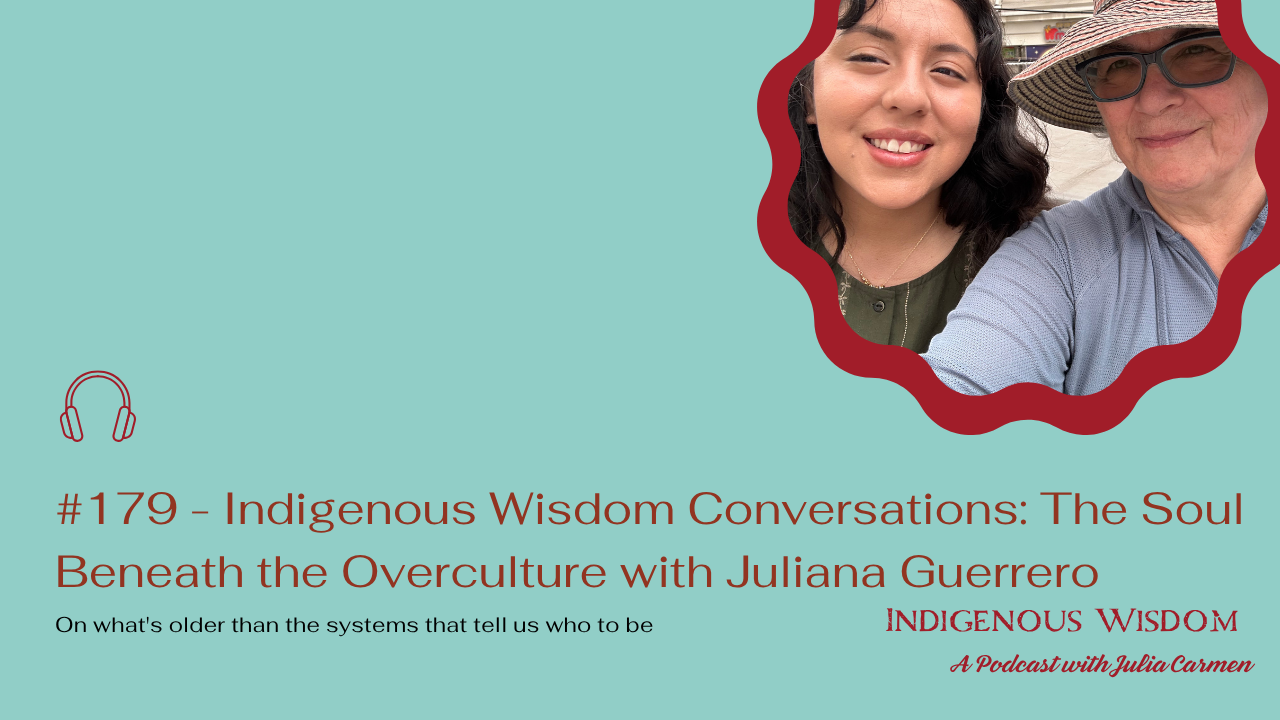
Episode 179: Indigenous Wisdom Conversations: The Soul Beneath the Overculture with Juliana Guererro
Jul 28, 2026Where did the word "overculture" actually come from — and why do we keep needing it?
In this J&J conversation — one of Julia Carmen's recurring sit-downs with her granddaughter, Juliana Guerrero — Julia traces the word back to Dr. Clarissa Pinkola Estés, by way of Women Who Run With the Wolves, a book she'd read so many times over thirty years that she'd forgotten where the word first came from. Juliana adds a second source: Dr. Magda Permut's essay "On Overculture," which reads Estés alongside bell hooks's "white supremacist capitalist patriarchy." Between the two, the word does specific work — it names whatever dominant force is running a family, a classroom, or a country, the hierarchy everyone quietly agrees to without ever quite questioning it.
Juliana brings the word into her own classroom, where she uses it to talk with her students about colonization and the forced removal of Indigenous peoples — plainly enough that they can hand the concept right back to her. Julia brings her own layer: growing up Mexican and Catholic in the mid-century U.S., inside an overculture that dictated marrying young and starting a family early, whether or not that fit who she actually was.
At the center of the episode, Julia reads a poem she wrote called "The Me and the Others" — about being a fair-skinned Mexicana whose own brown children have called her a "white Mexican," about the exhaustion of being asked, again and again, who are you, and what do you want from us? It isn't anger, she says. Just tired.
From there the conversation turns to what it costs a teacher to keep explaining her existence so that other people can feel comfortable, and where that explaining should end. They land where Julia always lands: the overculture didn't invent us, and it doesn't get the last word. Underneath it — older than it — is the Indigenous soul, and all of us are just trying to find our way back to it, one casita at a time.
"The overculture didn't invent us, and it doesn't get the last word. Underneath it — older than it — is the Indigenous soul.